
In his essay, “A Heritage of Smallness,” National Artist for Literature, Nick Joaquin, wrote:
“Enterprise for the Filipino is small stall: the sari-sari… Commerce for the Filipino is the smallest degree of retail: the tingi. What most astonishes foreigners in the Philippines is that this is a country, perhaps the only one in the world, where people buy and sell one stick of cigarette, half a head of garlic, a dab of pomade, parts of the content of a can or bottle, one single egg, one single banana.”
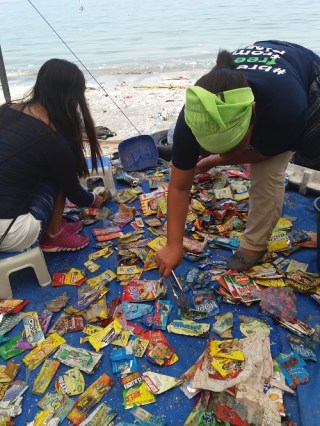
Indeed, we have a tingi culture. And I have heard it said quite a few times that it is this tingi mindset that allowed the proliferation of sachets in our society. Understanding this culture so well, big business gave us the sachets, promoting them as “pro-poor.” The narrative big business peddled is that by making their products available in small packets, people who would otherwise be unable to afford them can now enjoy them. And because it has always been part of our culture to buy small, these sachets were welcomed without much thought. If we think about it, buying things in sachets is also buying in tingi, only made more convenient.
I remember: When I was a young kid, whenever my mom would ask me to go to the sari-sari store to buy something, say ¼ of a bottle of vinegar, she would make me bring a container. The tindera (store owner/manager) would then pour the vinegar into the container.
Today, people still buy the same quantity of vinegar. But unlike before, they no longer bring container with them because the same quantity of vinegar (perhaps even smaller) now comes in a sachet. And they are not only available in sari-sari stores; they are in big groceries as well.
Before I came to understand the problem with sachets, I would have called it “parehong sistema, pinasosyal lang” (the same system, just made hipper). Now that I know a bit better, I say, “the same system, just made dirty.”
Yes, dirty because sachets, particularly plastic sachets, are made of fuel. Just think of the chemicals they contain, and how many of those chemicals may be harmful to you. But more importantly, dirty because they are designed for the landfill. They don’t have recycling value; once we’re done with them, we toss them onto the garbage bin, give them to the waste collector, who would then bring them to a landfill to sit for centuries, producing leachate that are harmful to the environment. That is, if they don’t get washed out to the sea, where they harm marine lives. But I digress.
As it is part of our culture to buy small, companies might claim they were just responding to our needs when they gave us the sachet. But the thing is, we never asked for sachets! The system of bringing our containers to the sari-sari store was working well, thank you very much! Until of course, big business introduced another narrative: Convenience is king!
I remember too, that it’s not only when we’d buy tingi from the sari-sari store that we would bring our own container. Again, during my childhood, whenever mom and I went to the public market, we would bring a basket with us. We used the basket to carry all the goods we bought. Plastic already existed at the time, but they were not free. If you wanted a plastic bag, you’d have to buy them. Just a few decades ago, this practice of bringing container to the store was the norm.
That changed over time, however. Now, even in the province, I no longer see people bringing container when they go to the market, much less to the grocery. Not even to the sari-sari store. Because now, plastic bags are everywhere and are free. It is only of late, due to years of pressure from environmental activists, that single-use bags are slowly being banned in various parts of the world.
As governments are banning single-use plastic bags with the gradual mainstreaming of Zero Waste, stores hailed as Zero Waste are now sprouting, especially overseas. But if you’d really look at it, many of the Zero Waste establishments are actually just stores that mimic our old way of shopping—stores that don’t use problematic packaging and require their customers to bring their own containers. These stores are showing the big business how to do it… how they should have done it.
Today, big business is telling us that their sachet is just a response to our tingi culture. That they came up with the sachet to enable the poor segment of the society to afford their product. But no, it is not that we are poor and that we buy tingi that plastic sachets came to be; it is that companies were focused solely on profit. Instead of developing a sustainable system that would support our tingi culture, they capitalized on it wantonly and without regard to the damage their packaging cause to the environment and to our health. It is their greed, nothing else, that made them package their products in problematic materials.
Buying tingi is not the problem. In fact, as many practitioners of Zero Waste now say, by buying only the things we can consume, we prevent wastage.
As an adult, I no longer buy ¼ bottle of vinegar (I now buy vinegar for our consumption by the bottle, and we now make our own vinegar for cleaning), but I also don’t buy perishables in bulk or very large bags. The idea is that we buy only the amount that makes sense, and that is, what we can actually consume—not too much so that we don’t waste them, and not too little for our actual need so that we don’t buy things in sachet.
I wish we will soon have Zero Waste stores in the country. Or shall I say, I wish our culture of bringing our own container would make a full comeback (because actually, we used to do things the Zero Waste way).
I hope more and more people would adopt that old practice. Because indeed, sometimes, the way forward is going back to our old ways of doing.
18 February 2018 | Sherma Espino Benosa
 THIS WAY INSTEAD